On August 8, 2007, Space Shuttle Endeavour launched from the Kennedy Space Center on mission STS-118, carrying seven astronauts to the International Space Station.
Less than a minute into the flight, debris from the external tank struck the underside of the orbiter. A strike like that had destroyed Columbia four years earlier, and the investigation that followed faulted not just the shuttle's hardware but the way NASA assessed, communicated, and managed flight risk. By the summer of 2007 the agency had new tools and procedures for inspecting an orbiter in flight, sizing up damage, and weighing a repair before reentry. STS-118 became the first real public test of all of it.
The briefings, engineering discussions, and crew interviews preserved in the spacearchive.ai collection let us follow the episode as it actually happened: how NASA's read on the damage shifted from one day to the next, how engineers weighed one risk against another, and how managers finally concluded that Endeavour could come home as it was.
A familiar problem, four years after Columbia
The loss of Columbia on February 1, 2003 changed how NASA thought about shuttle safety. The Columbia Accident Investigation Board traced the accident to a piece of insulating foam that broke off the external tank during launch and hit the reinforced carbon-carbon on the leading edge of the orbiter's left wing. But the board went well past the hardware, pointing to flawed risk assessment, poor communication, and a habit of treating dangerous conditions as acceptable simply because earlier flights had survived them.
The return-to-flight effort answered those findings with tank modifications, better launch imaging, on-orbit inspections, a repair capability, and changes to how missions were managed and overseen. In 2007 those reforms were still new, and while the agency had worked hard to stop the tank from shedding foam, it had not stopped it completely.
The first indications: "consistent with the last several flights"
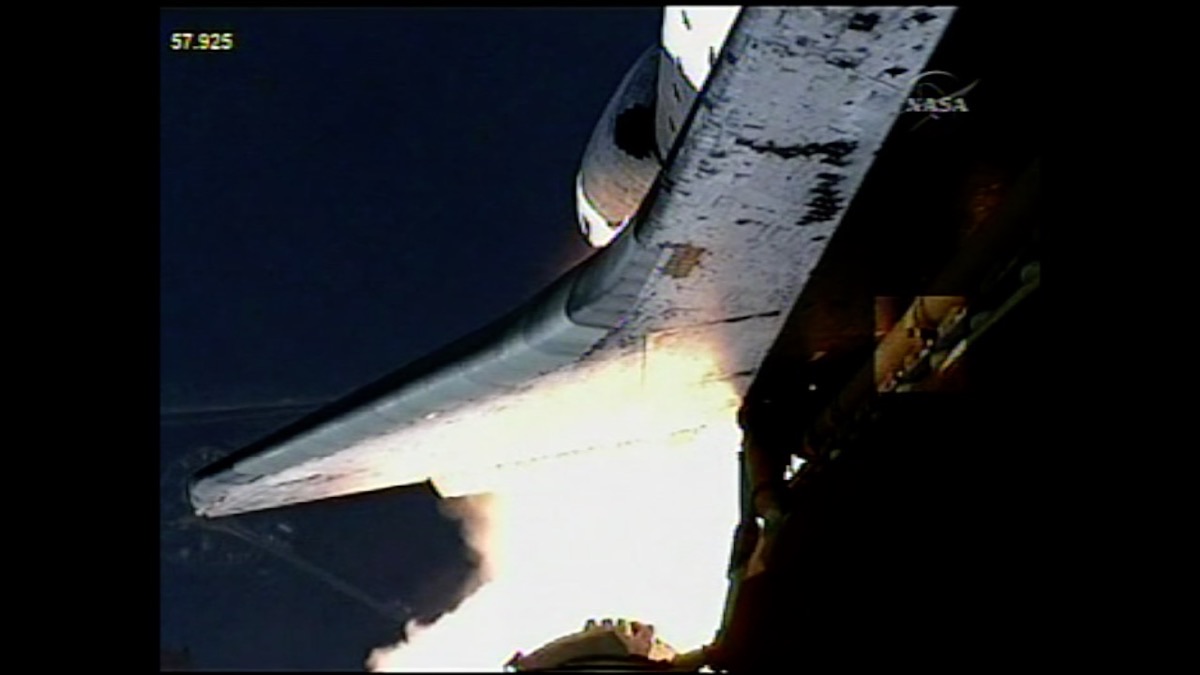
During Endeavour's ascent, imagery captured debris separating from the external tank.
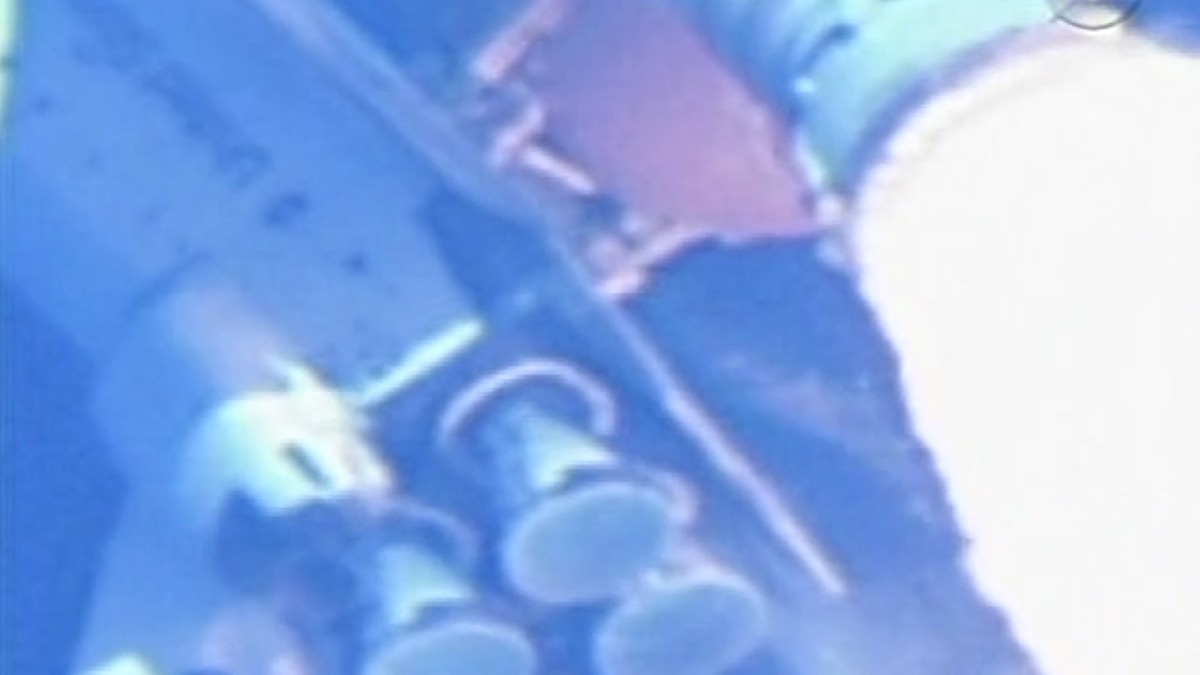
At first the debris looked unremarkable. During the Flight Day 2 Mission Management Team meeting, flight director John Shannon pointed to several small pieces of foam in the launch imagery, including a few that might have hit the orbiter, but called the footage "very consistent with the last several flights of the external tank" and said the team "didn't see anything new" that stood out.
One thing had changed, though. Rather than lean on that familiarity, the imagery team was already using the ascent video to flag specific spots on the orbiter to check during the later inspections. A debris event could look routine and still have to be run to ground.
Archive source STS-118 Flight Day 2 Mission Management Team briefing, AST-01149, approximately 6:05–9:49.
Finding the damage
As on every post-Columbia flight, Endeavour's crew had already surveyed the wing leading edges and nose cap with the Orbiter Boom Sensor System on flight day 2. That standard survey covered the reinforced carbon-carbon, not the lower-surface tiles where the gouge turned out to be, so managers deliberately deferred a look at the belly. As they put it in the Flight Day 2 briefing, they would "verify the entire condition of the underside of the orbiter tomorrow during the rendezvous."
That check came on August 10, as Endeavour approached the International Space Station. The shuttle performed a rendezvous pitch maneuver, slowly backflipping about 600 feet below the station so its crew could photograph the orbiter's underside with long lenses.
Those images revealed damage to the thermal protection system. NASA followed up with a focused inspection, using the robotic arm and the Orbiter Boom Sensor System to take detailed, three-dimensional measurements. The gouge ran about 3.5 inches long and 2.3 inches wide, spanned two adjacent tiles, and reached nearly through their full thickness.
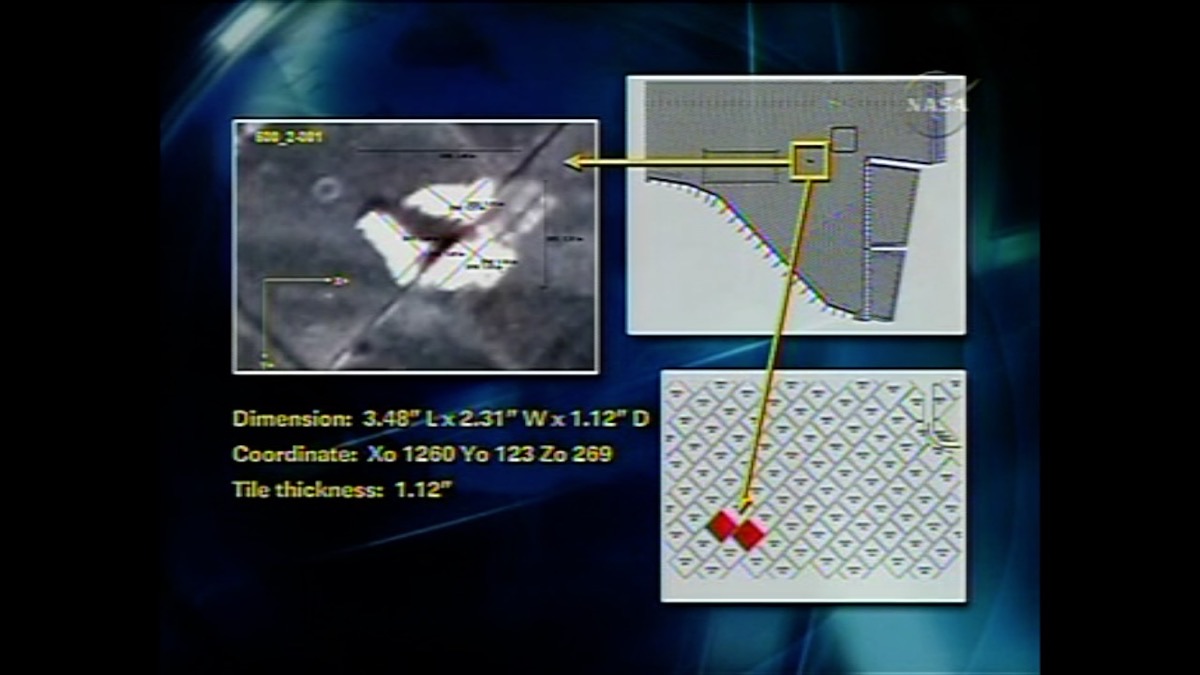
It was nothing like the breach that doomed Columbia, but it posed a real question: would what was left of the tile keep the orbiter's aluminum skin cool enough through the heat of reentry? This time NASA could actually dig into that, with imagery and inspection tools it had not had on Columbia's flight. Early on, managers were not even sure what had hit the orbiter. Launch radar first made the debris look more like ice than foam, and only over the next day, as booster-camera and launch footage were reviewed, did foam emerge as the culprit.
Reconstructing the debris strike
As more launch footage came in, engineers pieced together how it happened. At a later management briefing, Shannon walked through the imagery and diagrams: foam had come off a bracket on the external tank's liquid-oxygen feedline, hit a structural strut on the tank, and ricocheted up into the orbiter. It was that second impact, the rebound off the strut, that drove the debris into Endeavour's heat shield.
That mattered because NASA had seen foam come off this area before. In the Flight Day 11 briefing, Marcia Dunn of the Associated Press asked whether the agency had assumed foam from the bracket would simply drop away rather than bounce back into the orbiter. LeRoy Cain, chairing the management team, confirmed that the debris was already in NASA's probabilistic risk assessment, but the rebound was not: "We have this debris in our probabilistic risk assessment. And what we did not do is have the rebound consideration in there." The foam loss was familiar; the path it took was not. A known failure whose consequences had not been fully worked out is exactly the kind of blind spot the Columbia board had warned about.
Archive sources STS-118 Flight Day 4–5 Mission Management Team briefing, AST-01150, approximately 9:24–14:32; Flight Day 11 briefing, AST-01148, approximately 13:05–14:51.
From visual inspection to engineering evidence
Managers now faced two linked questions: was the damage dangerous enough to threaten the crew or the vehicle during reentry, and would fixing it in orbit actually lower the overall risk or just add new hazards? To get at them, NASA ran several lines of work in parallel.
- Detailed inspection. The Orbiter Boom Sensor System provided imagery and three-dimensional measurements of the damaged area, allowing engineers to reconstruct its geometry.
- Computational fluid dynamics. Engineering teams at NASA's Ames and Langley Research Centers modeled how high-temperature gases would flow through and around the cavity during reentry, using independent analysis methods.
- Thermal analysis. Engineers estimated temperatures within the tile and the underlying orbiter structure, comparing those predictions against acceptable limits.
- Arc jet testing. Ground facilities exposed representative damaged tiles to simulated reentry heating conditions, helping engineers evaluate the predictions of the analytical models.
- Repair evaluation. Mission managers and astronauts considered three repair approaches: an emittance wash, a screw-on protective overlay, and an STA-54 ablative material that could be applied during a spacewalk.
None of this was about whether the gouge merely looked bad. It was about whether the evidence actually supported flying home as it was, and whether a repair would make things better or worse. That took the work of several NASA centers, and it took time. To keep both options open, managers pushed the mission's fourth spacewalk back a day, leaving room to carry out a repair if the testing pointed that way.
Archive sources AST-01150, AST-01151, AST-01203.
The decision not to repair
On August 16 the management team made the call. After working through the analyses, the independent computer modeling, and the arc-jet tests, everyone agreed the damage was no threat to the crew during reentry. Whether to repair it anyway was the harder question. Johnson's engineering organization wanted to consider a patch to cut the chance of further damage to the orbiter; the engineering, operations, crew, and safety representatives mostly favored leaving it alone. The split was not about survival. It was about whether a repair actually lowered the overall risk.
The majority said fly it as it was, and the logic is worth sitting with. The damage had been measured, modeled, and tested, and the team knew how it would behave coming home. A spacewalk repair would have added its own hazards and changed the shape of the cavity, trading a problem engineers understood well for a patched surface they understood less. The real choice was not "do something" versus "do nothing." It was a well-characterized condition against a new and less certain one. Adding a fix is not the same as adding safety.
Archive source STS-118 Flight Day 6–9 Mission Management Team briefing, AST-01151, approximately 12:28–17:03.
The astronauts' perspective
The crew weighed in too, during their in-flight news conference.
Commander Scott Kelly backed the decision without reservation. Asked by a reporter whether NASA should "go the extra mile" and repair the tile anyway, he answered: "We agree absolutely, 100%, with the decision to not repair the damage. There was a lot of engineering rigor put into making this decision." The crew's concern, he noted, ran the other way: that attempting a repair "could potentially cause more damage to the underside of the orbiter."
Kelly also pointed to the time NASA had given itself. The fourth spacewalk, he said, was pushed back a day "to give themselves more time… and if it turned out the MMT decided we need to do a repair, we could have done it tomorrow with adequate cryo on board and safety margin to land safely."
That point lands differently against the Columbia findings, where schedule pressure and management decision-making were central criticisms.
The comparison deserves one important caveat. Endeavour was docked to the International Space Station and could draw on its power and consumables (STS-118 was, in fact, the first mission to use the new station-to-shuttle power transfer system), which gave managers a wide margin to take extra time. Columbia, on STS-107, flew a solo mission with no station to dock to; while that crew could have remained in orbit somewhat longer, its onboard reserves were finite. STS-118's managers simply had latitude that STS-107's did not.
With that margin in hand, the STS-118 recordings still show mission managers choosing to preserve time for additional technical analysis rather than treating the original schedule as an overriding constraint. The astronauts themselves recognized it as a deliberate and appropriate choice.
Archive sources STS-118 crew in-flight news conference, AST-01201; post-landing briefing, AST-01159.
A safe return, but not the end of the story
Endeavour landed safely at Kennedy Space Center on August 21, 2007, a day earlier than originally planned. With Hurricane Dean churning toward the Gulf and threatening Mission Control in Houston, managers chose to bring the orbiter home early rather than risk the storm.
The damaged area survived reentry without causing a loss of the vehicle or crew.
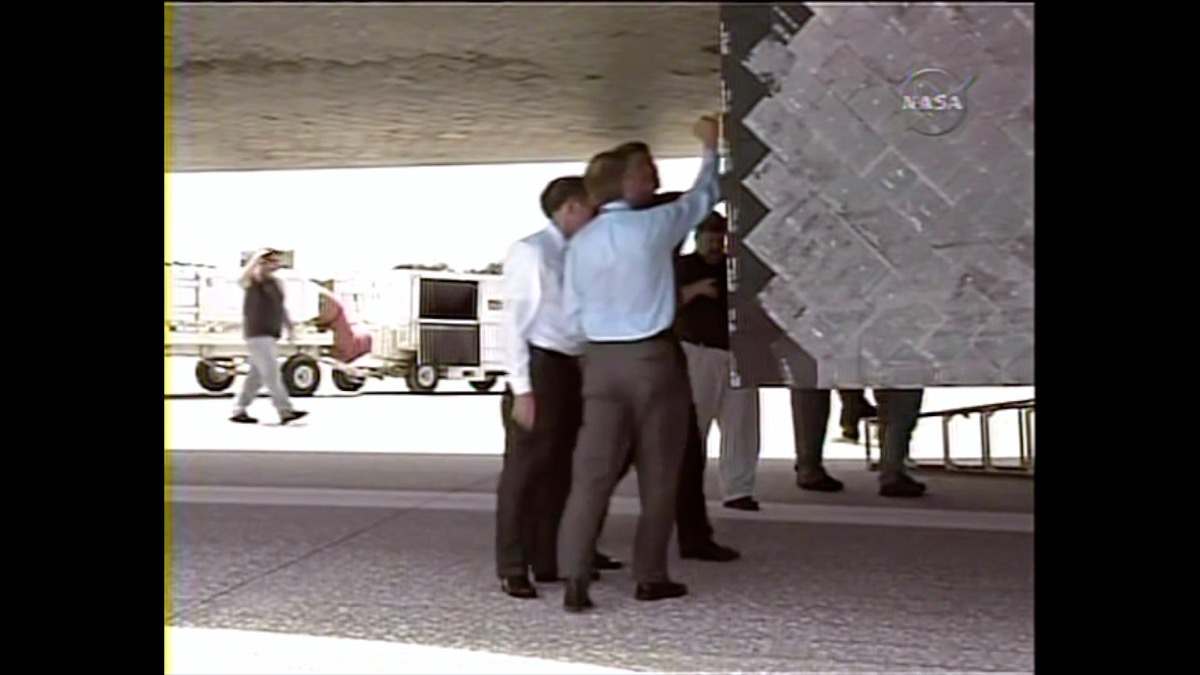
Still, a safe landing is not proof that the original risk was acceptable. STS-118 showed two things at once. Four years after Columbia, NASA was still shedding foam and still learning how that foam could behave. And NASA was now far better at catching the damage, building the engineering case, weighing a repair, and documenting the decision. The recordings capture both the limits of the hardware and how far the agency had come in managing the fallout, which is what makes the mission worth studying.
What the archive makes possible
Piecing this together the old way would mean hunting down a stack of NASA recordings and sitting through hours of press conferences, because the story is scattered across them. One briefing describes the damage, another explains the cause, a third lays out the analysis, and a crew interview covers the final call. No single tape holds the whole arc.
That is the problem this archive is built to solve. The recordings are transcribed, tagged, and searchable, so related moments from different flight days can be pulled into one thread, the way they are here. The result is not meant to replace the record; it points straight back to it. Every claim traces to a specific recording, with timestamps, so a researcher can go hear what was actually said and tell the documented facts apart from any reading laid over them. Instead of leaning on a tidy summary written after the fact, you can watch the decision take shape in the words of the people who made it.
Preserving the decision-making, not just the outcome
STS-118 is usually remembered as a routine station-assembly flight. The two damaged tiles are the more interesting story: a close look at how NASA handled a recurring hazard after Columbia, how the new procedures held up under real pressure, and where the uncertainties still lived.
What's worth keeping is not just that Endeavour made it home. It is the full record of how NASA got from a first blurry debris frame to a decision it could stand behind, disagreements and all. The recordings don't only show what happened. They show why the people in the room decided the way they did.